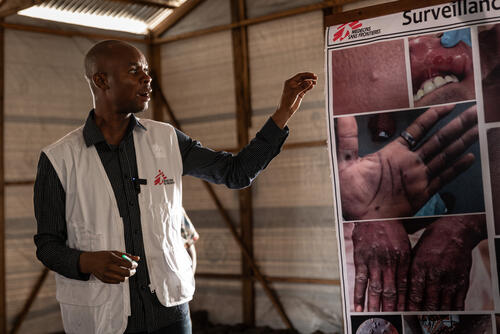
The MSF Scientific Days bring together researchers, innovators, and advocates in humanitarian global health to discuss and challenge research from within the sector.
MSF Scientific Days is a free, annual global health and humanitarian research conference in London, bringing together researchers, clinicians, innovators, and advocates from around the world.
Focused on medical research in fragile, conflict-affected, and crisis settings, the conference highlights how high-quality research can improve care, inform policy, and strengthen humanitarian response.
Save the date: MSF Scientific Days 2027 is taking place on Thursday 29 April 2027
Submit your research for MSF Scientific Days 2027
Do you have medical research or an innovation that can improve how Médecins Sans Frontières delivers healthcare in humanitarian settings?
Submit your abstract for the chance to present your work to MSF staff, academics, researchers, and leading journalists at MSF Scientific Days 2027.
Deadline for abstract submission: Sunday 6 December 2026 at 23:59 GMT
Whether you have generated new evidence, tested an innovative approach, documented programme learning or identified an important question for future research, we want to hear from you!
Once submitted, your work will also be considered for MSF Scientific Days events in Asia, Latin America, and Southern Africa.
Want to see what you could be part of in 2027? Read our blog reflecting on the 2026 event, or catch up on recordings and presentations on the MSF Science Portal.
Submissions are accepted in English, French, and Spanish.
Who should attend?
MSF Scientific Days is open to anyone interested in global and humanitarian health, including:
- Researchers and academics
- Healthcare professionals
- Humanitarian workers
- Policy-makers
Sign up to our mailing list to stay up to date on all the latest news:
You can catch up and watch the 2026 UK conference online here
2026 programme highlights
Keynote: Research under fire – lessons from Gaza
Dr Akihiro Seita and Dr Masako Hoshino (The United Nations Relief and Works Agency for Palestine Refugees in the Near East (UNRWA)) will discuss conducting research under fire, focusing on their month-by-month analysis of acute malnutrition during the war in Gaza. Their work contributed to the IPC famine confirmation in Gaza City and highlighted the impact of restricted humanitarian aid on child malnutrition.
Keynote Panel: Beyond health – can MSF's research serve as testimony?
Featuring Professors Larissa Fast, Jerome Singh, Debarati Guha-Sapir, and Melissa McRae.
MSF’s research increasingly documents patterns of violence, neglect, and violations – but should these data ever be used as testimony in international investigations or judicial processes? And if not, what are the limits of what we are willing to do with what we know? In this keynote panel we will explore whether, and under what conditions, MSF’s research can contribute to accountability and justice, and what this would mean for our ethics, research methods, and operational access.
Presentations
- Promising results on integrating the R21 malaria vaccine with seasonal malaria preventative medications shows improved coverage for children in high-burden settings
- New findings from Ethiopia on the use of a snakebite antivenom which requires no cold chain and can be used for many types of bite offers valuable insights into improving treatment for snakebite in resource-limited contexts
- A simplified, single-dose treatment for HIV-associated cryptococcal meningitis (AmbiOne study) could make lifesaving care more feasible in low-resource settings
- Research from Gaza highlights the scale and complexity of trauma and surgical care in conflict settings, underscoring ongoing humanitarian needs
- Innovative approaches to care delivery, including peer-led HIV prevention and community-informed research, which are helping to reshape programmes to better reach vulnerable populations
Recordings of all presentations are available on the MSF Science Portal >
Recordings of all presentations are available on the MSF Science Portal >
Highlights from our 2023 event
Missed our event on 7 June 2023? You can find all of our content on the MSF Science Portal
Our 2023 event showcased research conducted by MSF, its partners and beyond, and featured four sessions on topics ranging from tuberculosis and operational strategies to reproductive health and outbreaks. Some of the emerging themes were:
- The importance of meaningful patient engagement to achieve more appropriate research and interventions. Sohana Saddique presented on a successful collaboration between MSF and two factories in Bangladesh to improve workplace safety. Here, active participation from the factory owners and workers helped in co-creating effective interventions and infrastructure changes that could be sustained in the absence of MSF.
- The scope of humanitarian health action was questioned, particularly the extent of MSF’s responsibilities in situations that require longer term presence. In addition to this, Sakib Burza urged us to look beyond the immediate impacts of humanitarian health action, presenting an example of the environmental benefits that can be achieved by providing support to communities in ecologically critical areas in Borneo. Average deforestation rates were significantly lower in villages provided with healthcare and livelihoods support, illustrating that the resilience of these communities is tied to the environment.
- The urgency to move beyond solely lifesaving activities was highlighted as our focus begins to expand to include measures of quality of life and patient-reported outcomes. This attitude shift was discussed during Beverley Stringer’s presentation on patient experiences from the TB-PRACTECAL clinical trial and emphasised in Matthew Coldiron’s presentation on the need for aftercare in light of the long-term effects of a meningitis epidemic that occurred in Niger in 2022.
Finally, two noteworthy studies from our partners were presented which we want to highlight:
Epicentre’s Estelle Pasquier on the high severity of abortion complications in fragile and conflict-affected settings, and DNDi’s Alexandra Solomos on a shorter, safer treatment for visceral leishmaniasis.
If you missed previous events you can catch up here:
MSF Asia Scientific Day 2022
MSF Scientific Day International 2022
MSF Scientific Day Southern Africa – Zimbabwe
Visit the MSF Science Portal to watch all content from previous years