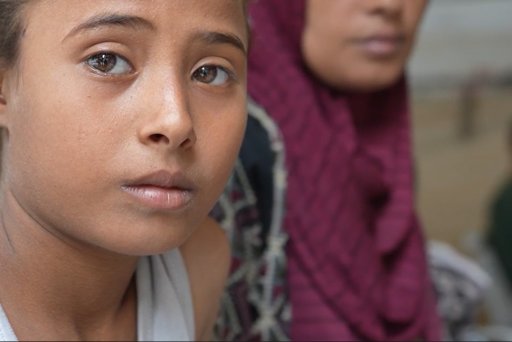
These testimonies describe the situation of tens of thousands of refugees who have fled fighting in Sudan since the autumn of 2011. In Jamam camp, currently sheltering a quarter of the refugees, mortality rates are now above emergency levels, with 1.8 per 10,000 people dying each day.

These testimonies describe the situation of tens of thousands of refugees who have fled fighting in Sudan since the autumn of 2011. More than 120,000 people are now seeking refuge in South Sudan's Upper Nile State. In Jamam camp, currently sheltering a quarter of the refugees, mortality rates are now above emergency levels, with 1.8 per 10,000 people dying each day.

To help MSF's work in South Sudan, donate here

Shaba

Shaba is 35 years old and has been living in Jamam camp with her family since December.

Shaba is 35 years old and has been living in Jamam camp with her family since December.

Shaba is 35 years old and has been living in Jamam camp with her family since December. © Corinne Baker/MSF

“We left our village Buk in September because there was fighting. In Buk, we had everything, but now we are naked. Four people in our village were killed in the fighting. My husband and I ran with our five children, but we got separated. We ran because of fear. My husband had three children and I took two. After one day’s walk, we met again in Kukur.

Bombings

"In Kukur life was difficult. The men would sometimes go back to Buk to get food, but there were so many people, there was not enough. There were bombings in Kukur, sometimes at night, sometimes early in the morning, sometimes during the day. No one would light a torch or a fire because we were afraid of being bombed.

"Bombs hit near our shelter in Kukur. We left Kukur to come to Jamam because we heard there was a safe place here. We walked for 12 days. We took some sorghum with us, but it wasn’t enough. Everyone was tired and the children had diarrhoea.

"Two weeks ago my two year old daughter died. She had been sick for three months and she died from diarrhoea.

Sharing water

"The main problem in Jamam has been water. There has not been enough to drink. It takes a long time to get water to drink. We fill three jerry cans – one for breakfast, one for cleaning and one for the evening. Some people are old and can’t fetch water. Sometimes our neighbours can’t fetch water so we share with them.

"The other problem here is the flooding. Five days ago, we moved our tents across the road because they were completely flooded. The night it rained, our tents filled with water. Everything was wet and no one was able to sleep.

"The children were cold and crying. The sorghum and all our clothes were wet. There was no dry space to cook food so we spent a day without food. Since the rain, I have been sick with a fever and cough. I haven’t been to the clinic yet because I was too weak. But I know about the clinic and I will go.

"If there is peace, we want to return home, but if not we will stay here. But I want to move to a better place because here there is flooding.”

Sheik Osman

Sheik Osman is 55 years old, a father of seven and the leader of 500 households. He fled his village Kwaimol in September, along with 18 of the households in his group. They have been living in Jamam camp since December.

heik Osman is 55 years old, a father of seven and the leader of 500 households.

Sheik Osman is 55 years old, a father of seven and the leader of 500 households. © Corinne Baker/MSF

“In September, the bombing of our village started. When the planes dropped bombs, they burnt everything, including the houses. The planes would come at night to drop the bombs, but sometimes they would come during the day. Then they would bomb all day. When one plane finished, another would come and take its place. We would run and hide in the grass and bushes.

Fleeing violence

"When we ran, we went with difficulty. One man was carrying three children on his back. I was carrying two children on mine. I have seven children, but only five of them came to Jamam. The other two went missing in September when they were grazing cattle and I haven’t heard if they are alive. We would run and find somewhere safe and we would rest for one day, but then the planes would come again and we would run.

"In Kwaimol, life was comfortable. When we ran, we left everything – the cattle, hens and sorghum. Because of the war, we left everything there. Everyone left all their things when they scattered. I don’t think about the things I left behind. We came only with the clothes on our bodies. That is what we have been wearing until now. These are the shoes I was wearing when I left.

Water shortages

"We spent four months travelling and finally reached El Fuj [the border crossing point] at the end of December. In El Fuj we had some rest, but then the planes came and bombed there as well. When we arrived in Jamam I was happy to be in a safe place with no fighting. We were given food and so the children could eat.

After six centimetres of rain in just an hour and a half  on the night of the 28 June, parts of the transit camp were flooded.

After six centimetres of rain in just an hour and a half on the night of the 28 June, parts of the transit camp were flooded. © Corinne Baker/MSF

"But there was a problem here of water. There are many people so sometimes the water runs out. Usually around 4 o’clock the water will be drained and sometimes there is not enough for cooking so we save it for drinking. Since we reached Jamam there have been many people sick. We walked such a long way and many people had joint pain and diarrhoea.

Flooding

"The problem here is the flooding. When it rained last week, some tents fell down because of the flooding. The tents were flooded and everything was wet. The children were raised above on the beds to sleep, but the ground was full of water.

"The children became sick because of the cold. Some had coughs and fevers and we took them to the clinic and they became better. Some had diarrhoea and we took them to the ORS [oral rehydration salt] point and they became better. One girl has a fever and a cough and some chest pain and is not better yet.

"We want to move to drier ground, because the Sheik in Jamam tells me that in August and September there is a lot of flooding and this area will be full of water. I think about my homeland and I want to go back. But I only want to go home when there is peace. Because of the war, we are still here."

  • Emergency in South Sudan

    MSF has been providing aid to refugees in Upper Nile State since November 2011. Our teams are running two field hospitals in Jamam and Doro camps, where they provide more than 3,000 consultations a week. MSF teams provide more than 6,000 consultations per week for the refugees in Upper Nile State. The organisation is also distributing basic survival items (like plastic sheeting, blankets and jerrycans), operating water and rehydration points, monitoring the mortality and morbidity among newly arrived refugees and provided emergency assistance to refugees who were moving from the border towards and between camps.


To help MSF's work in South Sudan, donate with the button below.


Refugee activity map in Upper Nile State, South Sudan, 5 July 2012.